

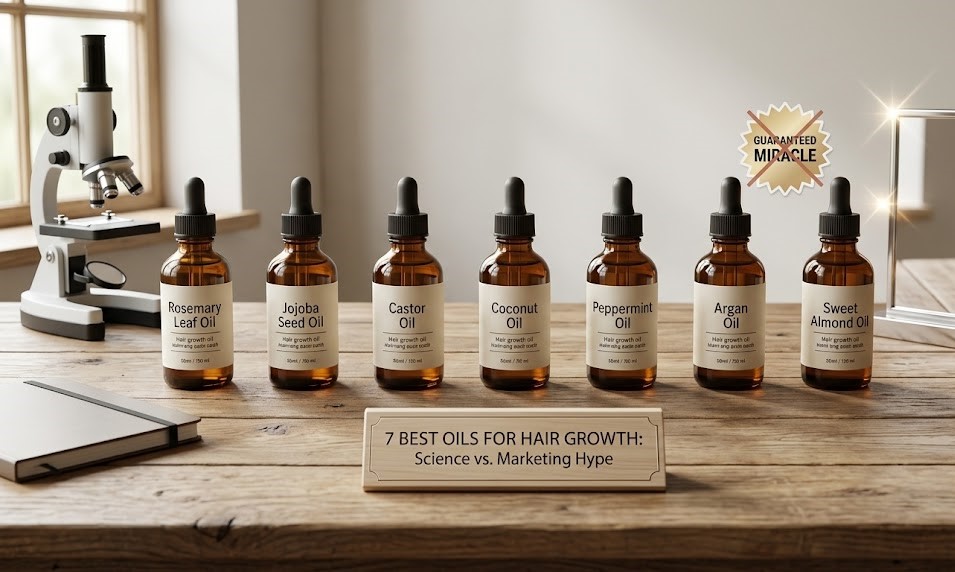

The hair-loss industry is flooded with “miracle” oils. From rosemary and castor to the viral batana oil, it is often difficult to distinguish traditional folklore from clinical proof. While natural oils offer a safer profile than some synthetic drugs, popularity does not always equal effectiveness.
In this guide, based on research by Sophie Grice, PhD, we rank the top 7 oils based on human clinical data, hair-count improvements, and real-world safety.
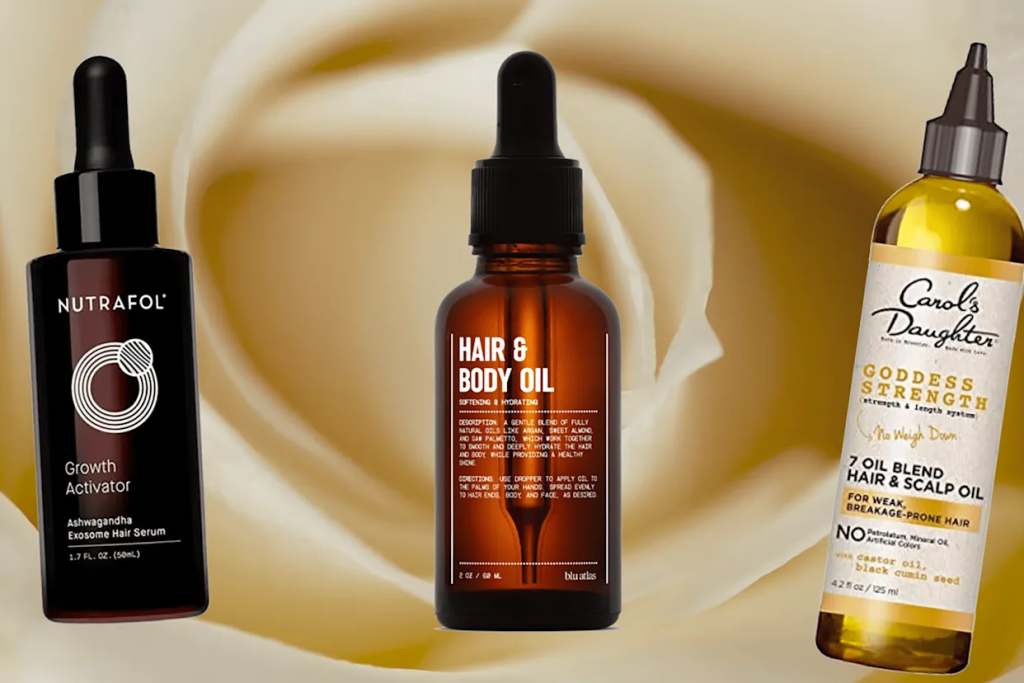
How to Spot “Science-Backed” Marketing Traps
Before looking at the rankings, it is important to understand how brands often “game” the science:
- The “Mouse Model” Trap: Just because an oil grows hair on a lab mouse doesn’t mean it works on a human scalp.
- Vellus vs. Terminal Hair: High-growth claims often count “peach fuzz” (vellus hair) rather than the thick, pigmented strands (terminal hair) that actually provide coverage.
- Oral vs. Topical: A study showing that eating pumpkin seeds helps hair does not prove that applying the oil to your head does the same.
Top 7 Oils for Hair Growth (Ranked by Evidence)
1. Topical Saw Palmetto (Sabal fructus)
Saw palmetto is often called “nature’s finasteride” because it aims to block Dihydrotestosterone (DHT), the primary hormone responsible for pattern baldness.
- The Evidence: A 16-week study showed a 22% reduction in shedding and a 7.6% increase in density.
- The Verdict: It is an excellent stabilizer. It helps keep the hair you have, though it rarely regrows a completely bald patch on its own. You can find more about saw palmetto studies at PubMed.
2. Rosemary Oil
Rosemary is currently the most popular natural alternative to Minoxidil. It is believed to improve blood circulation and provide antioxidant support to the follicles.
- The Evidence: A 6-month trial compared rosemary oil to 2% Minoxidil. Both groups showed similar (modest) hair count increases.
- The Verdict: It is a viable alternative for those sensitive to chemicals. However, remember that most clinical results compare it to the weaker 2% Minoxidil, not the standard 5% strength found in products like Rogaine.
3. Pumpkin Seed Oil
Rich in Omega-3/6 fatty acids and Vitamin E, pumpkin seed oil works as a topical anti-inflammatory.
- The Evidence: In a head-to-head study with 5% Minoxidil foam, pumpkin seed oil showed measurable improvements in hair shaft diversity. However, Minoxidil remained significantly more effective.
- The Verdict: Best used as a supportive adjunct to provide the scalp with essential nutrients.
4. Castor Oil
Despite being a “cult favorite” on social media, castor oil has almost zero human clinical data for actual hair growth.
- The Reality: Its strength lies in hair fiber protection. It is a heavy occlusive that coats the hair shaft, preventing breakage and making hair appear thicker.
- The Verdict: Great for conditioning and shine, but don’t expect it to revive dead follicles.
5. Peppermint Oil
Peppermint oil creates a “tingling” sensation that many associate with growth.
- The Evidence: Most “proof” for peppermint comes from a single 2014 study on mice. In that study, it outperformed Minoxidil, but this has not yet been replicated in human trials.
- The Verdict: Hypothetically stimulating, but currently lacks the human data to be a primary recommendation.
6. Lavender Oil
Lavender is primarily used for its anti-inflammatory and antimicrobial properties.
- The Verdict: It is excellent for improving scalp health (reducing dandruff or irritation), which creates a better environment for growth.
7. Batana Oil
The newest “super-oil” to go viral, Batana oil comes from a native Honduran palm.
- The Verdict: Evidence is entirely anecdotal. While the “Tawira” people have used it for centuries to maintain long, strong hair, there are no randomized controlled trials (RCTs) to back up its growth claims in 2026.
Summary Comparison Table
| Oil | Primary Benefit | Regrowth Potential | Recommended Use |
| Saw Palmetto | DHT Blocking | Moderate (Stabilization) | Daily leave-in |
| Rosemary | Circulation | Mild | 2x Daily (Diluted) |
| Castor | Anti-Breakage | Low (Appearance only) | 1x Weekly mask |
| Pumpkin Seed | Scalp Nutrition | Mild | 3x Weekly |
Next Steps for Your Regimen
If you want to try these oils, remember the 6-month rule: hair growth is a slow physiological process. You must be consistent for at least half a year before judging the results. For medical-grade guidance, you can also check the American Academy of Dermatology.