

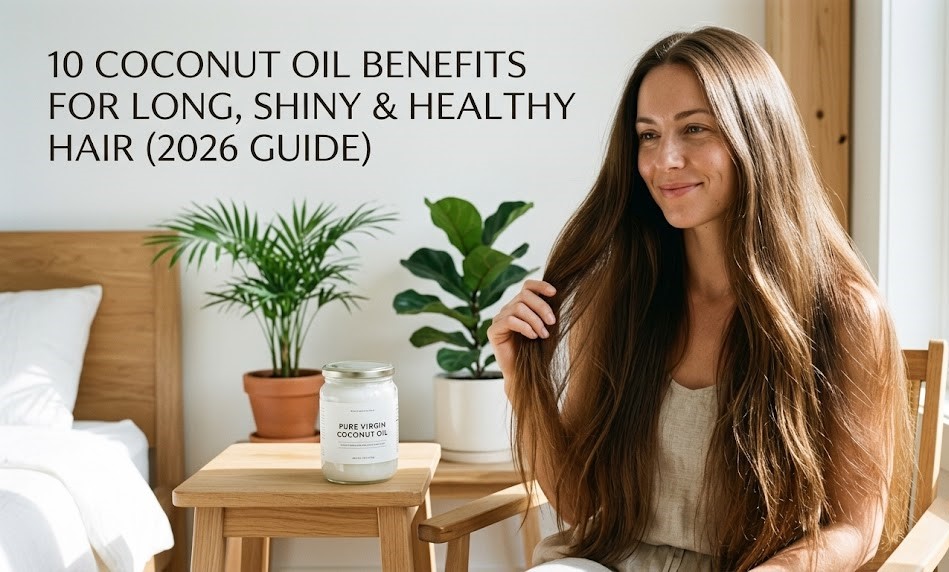

Let’s be completely candid: our hair is our crowning glory. However, daily grooming, aggressive heat styling, stress, and harsh environmental pollutants can quickly leave it looking dull, dry, and damaged.
- At a Glance: Top 10 Coconut Oil Benefits for Hair
- The Science: Why Coconut Oil Beats Other Hair Oils
- 5 Smart Ways to Use Coconut Oil in Your Routine
- Level Up: Build a Complete Hair Care Regime
- Step 1: Oiling with Rice Extracts
- Step 2: Shampooing for Your Scalp Type
- Step 3: Deep Conditioning
- Step 4: Weekly Hair Masks
- Frequently Asked Questions
When your modern hair care routine stops working, it is time to go back to the basics. In ancient Indian medical science (Ayurveda), the coconut is considered the perfect fruit. Because coconut oil is uniquely rich in saturated fats, potassium, and lauric acid, it penetrates the hair shaft better than almost any other natural product.
If you have ever wondered why your grandmother constantly told you to oil your hair, here is a straightforward, science-backed breakdown of exactly why coconut oil is the ultimate remedy for long, shiny, and healthy hair.

At a Glance: Top 10 Coconut Oil Benefits for Hair
| The Benefit | The Science & Impact |
| 1. Deeply Moisturizes | Penetrates deep into the scalp to lock in moisture and prevent strands from drying out. |
| 2. Prevents Split Ends | Binds to hair proteins to actively undo split ends and prevent structural breakage. |
| 3. Fights Dandruff | Antibacterial properties kill fungi, while lauric acid controls excess sebum production. |
| 4. Tames Frizz | Saturated fats smooth down the hair cuticles, making strands softer and more manageable. |
| 5. Promotes Growth | Nourishes the scalp, improves blood circulation, and supports new hair follicle development. |
| 6. Tackles Premature Graying | Retains proteins and nourishes the hair from within, slowing the loss of natural pigment. |
| 7. Reduces Inflammation | Anti-inflammatory properties soothe an irritated, itchy scalp. |
| 8. Adds Luster & Shine | Secures moisture to leave behind a brilliant, healthy shine on dull hair. |
| 9. Detangles Easily | Hydrates the hair to give it a slippery texture, preventing painful knotting and pulling. |
| 10. Protects from UV Damage | Vitamin E and a natural SPF concentration protect the hair from free radicals and sun damage. |
The Science: Why Coconut Oil Beats Other Hair Oils
Compared to other popular oils like argan or rosemary, coconut oil is biochemically superior at healing dry, brittle strands.
According to research from the National Institutes of Health (NIH), coconut oil is predominantly made of lauric acid. This specific fatty acid has a low molecular weight and a straight linear chain. This allows it to physically penetrate inside the hair shaft, rather than just sitting heavily on top of it like mineral oil does. This deep penetration is what actively stops protein loss and strengthens the hair from the inside out.
5 Smart Ways to Use Coconut Oil in Your Routine
Coconut oil can be highly beneficial, but applying it incorrectly will leave your hair looking flat and greasy. Follow these expert rules:
- Warm It Up: Hot oil penetrates the scalp and roots much more easily. Place a small amount of oil in a bowl, and let that bowl sit in hot tap water until it melts. (Warning: Never microwave the oil).
- Apply in Sections: Split your hair and apply the oil in manageable portions. Focus the heaviest amount on your damaged ends, and use less near your scalp if your hair is naturally thin or prone to greasiness.
- Use as a Pre-Wash Mask: Let the oil remain on your hair for 20 to 30 minutes before you shower. For severely damaged hair, leave it in overnight and wash it out the next morning.
- Boost with Heat: After applying the oil, wrap your hair in a hot towel or use a hairdryer on low heat for a few minutes. This opens the hair cuticle, allowing the oil to penetrate even deeper.
- Double Cleanse: Because coconut oil is stubborn, you will likely need to shampoo your hair twice to completely remove the slick residue.
Level Up: Build a Complete Hair Care Regime
To maximize the benefits of coconut oil, you need to incorporate it into a holistic routine. Here is how to build a regimen using targeted products:
Step 1: Oiling with Rice Extracts
We highly recommend pairing coconut oil with the antioxidant power of fermented rice water. The Mamaearth Rice Hair Oil blends coconut oil with rice extracts to accelerate hair growth, prevent bacterial buildup, and intensely nourish the roots.
Step 2: Shampooing for Your Scalp Type
You must keep your scalp clean of dust and excess sebum to allow the oil to work. If you suffer from a flaky, itchy scalp, try a formula rich in Tea Tree Oil. It naturally controls dandruff while Vitamin E enhances blood flow to prevent breakage.
Step 3: Deep Conditioning
Never skip the conditioner. An effective conditioner locks in the moisture you just provided. Look for formulas containing Keratin and coconut oil to restore smoothness, reduce frizz, and repair structural damage caused by heat styling.
Step 4: Weekly Hair Masks
To keep your scalp entirely free of product build-up, use a natural hair mask once a week. An Onion Hair Mask is excellent for providing intense nourishment and actively promoting new hair growth.
Frequently Asked Questions
Can I use coconut oil on my hair every day?
While there are no reported side effects, using it daily can quickly lead to product build-up and a greasy appearance. Most dermatologists recommend using it as a deep treatment once or twice a week.
Does coconut oil actually regrow hair?
Coconut oil helps hair grow stronger and longer by preventing breakage. While it provides nutrients that support a healthy scalp, there is no scientific evidence that it can magically regrow hair on dead follicles. If you are experiencing severe hair loss, consult a specialist from the American Academy of Dermatology (AAD).
Is coconut oil good for dandruff?
Yes. The lauric acid in coconut oil helps manage excess sebum production (a leading cause of dandruff), while its antibacterial properties kill the fungi responsible for a flaky scalp.
Also Read : Brahmi Benefits for Hair That You Should Know! (2026 Guide)